
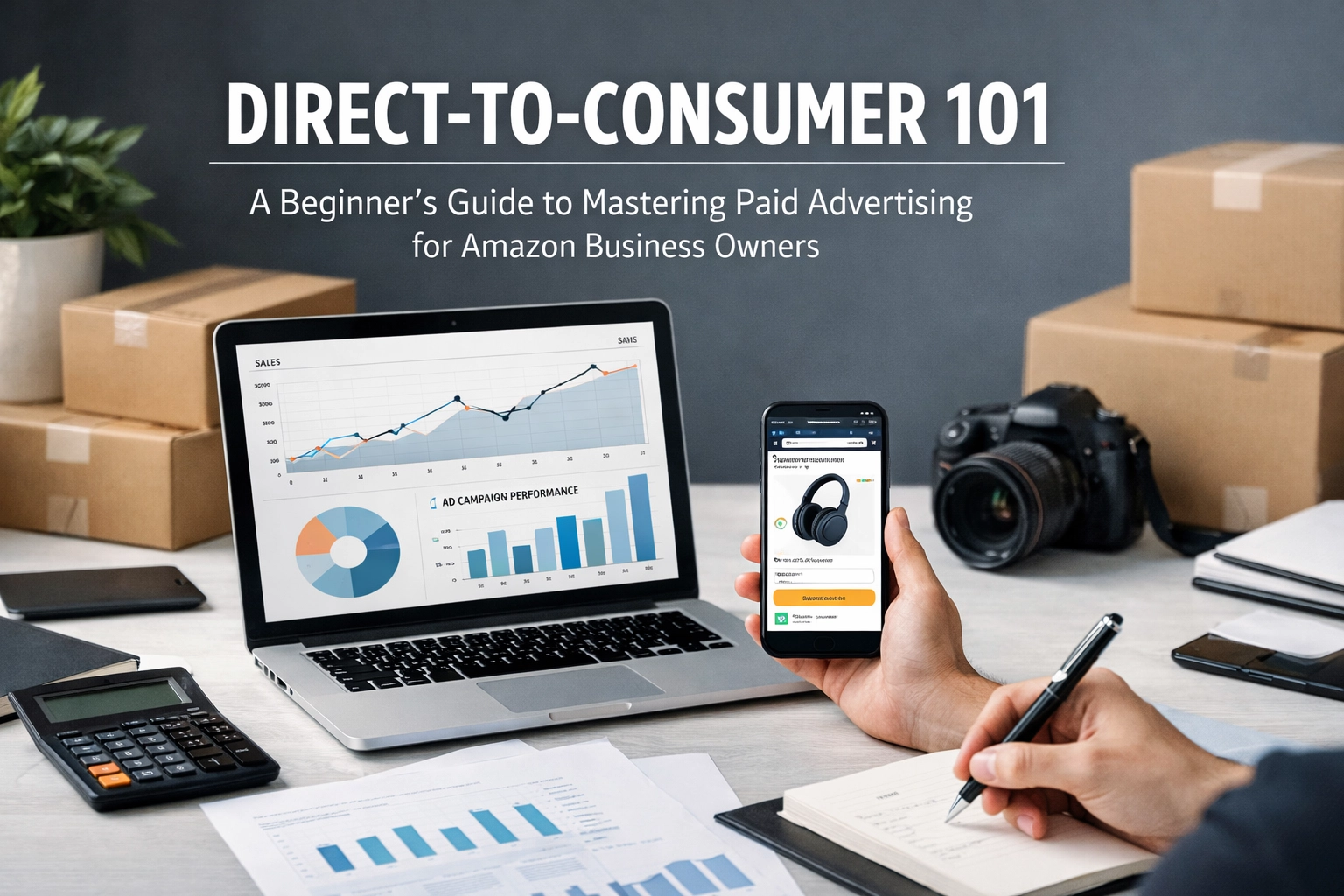
Are you tired of Amazon taking a massive 30% (or more!) cut of your revenue while keeping your customers’ email addresses under lock and key? Let’s face it: while the Amazon marketplace is a phenomenal engine for moving volume, it’s also a bit of a golden cage. You have the sales, sure, but do you really have a brand?
If you’ve been relying solely on Sponsored Products and the "A9" algorithm to drive your business, moving into the world of Direct-to-Consumer (DTC) can feel like stepping out of a climate-controlled shopping mall into the wild, unpredictable jungle. But here’s the visionary truth: the future of e-commerce isn’t just about being a "seller", it’s about being a destination.
At Positive Sparks, we’ve helped countless Amazon veterans make this leap. We know that the transition from marketplace dominance to DTC success isn’t just a technical shift; it’s a psychological one. Today, we’re breaking down how to master paid advertising to boost sales e-commerce wide, taking your brand from an Amazon listing to a household name.
Why Bother with DTC When Amazon Is Already Printing Money?
You might be thinking, "Phil, if it ain't broke, why fix it?"
Well, bear in mind that 54% of consumers now prefer to buy directly from brands rather than through third-party marketplaces. Why? Because they want the story, the connection, and the specialized customer service that Amazon simply can't provide.
When you own the store (your own website), you own the data. You own the pixel. You own the relationship. In the Amazon world, those customers belong to Jeff. In the DTC world, they belong to you. This shift allows you to implement direct to consumer marketing strategies that build long-term equity, not just short-term transactions.

The "Amazon Brain" Trap: Why ACoS Isn't Everything
The first hurdle for Amazon business owners is unlearning "Amazon Brain." On Amazon, you’re obsessed with ACoS (Advertising Cost of Sales). You want it low, and you want it now.
But in the DTC world, we talk about ROAS (Return on Ad Spend) and, more importantly, LTV (Lifetime Value). When you run Meta or Google Ads to your own site, your initial customer acquisition cost (CAC) might be higher than a Sponsored Products click.
"Is it worth it?" you ask.
Absolutely. Because once that customer lands on your site, you can capture their email, pixel them for retargeting, and sell to them again and again for free. If your Amazon ACoS is 20%, but your customer never buys from you again, you’re on a treadmill. If your DTC ROAS is lower initially, but that customer buys three times a year, you’ve just built a real business.
Step 1: Meta Ads – The Discovery Engine
If Amazon is where people go when they know what they want, Meta (Facebook and Instagram) is where they go to discover what they need. For Amazon sellers moving to DTC, Meta Ads are your best friend.
Why? Because you already know your customer profile. You know the demographics of the people buying your ergonomic office chairs or organic dog treats on Amazon. Use that!
Actionable Takeaway: Start with a "Broad" targeting strategy on Meta. Trust the AI. By using high-quality video creative that highlights the "why" behind your brand, you allow Meta’s algorithm to find your buyers. Unlike Amazon, where you bid on "dog treats," on Meta, you’re bidding on the person who loves their pup like a child.

Step 2: Google Ads – Capturing the High-Intent Traffic
While Meta creates demand, Google captures it. When someone searches for "best organic dog treats for seniors," you want your DTC site to be the first thing they see: not just your Amazon listing.
For Amazon business owners, Google Shopping is the closest equivalent to what you’re used to. It’s visual, it’s intent-based, and it’s highly effective. However, the trick to boosting sales e-commerce style is integrating your Google strategy with your broader brand vision.
If you're feeling overwhelmed by the technical side of tracking all this (trust us, GA4 is a different beast compared to Amazon Seller Central), it might be worth looking into a Google Analytics agency to make sure your data is actually telling the truth.
Step 3: The Power of First-Party Data
Remember how we said Amazon keeps your data? In DTC, your first-party data is your most valuable asset. Every time someone clicks an ad and visits your site, they leave a "breadcrumb."
We’ve seen brands increase their ROAS by 30% just by properly utilizing their email lists for "Lookalike" audiences on Meta. You can't do that on Amazon. By feeding your own customer data back into your ad platforms, you create a "virtuous cycle" where your ads get smarter and cheaper over time.
If you're curious about how to measure this beyond the basic dashboard, check out our guide on unlocking the power of 3rd party attribution.
Step 4: Creative is the New Targeting
On Amazon, your "creative" is basically your main image and some bullet points. In the DTC world, creative is the variable that determines whether you scale or fail.
Let's face it: people don't go to Instagram to be sold to. They go to be entertained or inspired. Your ads need to stop the scroll. We recently worked with a client who was moving their high-end cookware from Amazon to Shopify. Their Amazon ads were functional and boring. For their DTC launch, we switched to "User-Generated Content" (UGC) showing real families cooking together.
The result? A 45% decrease in cost-per-acquisition.
Actionable Takeaway: Don't just copy-paste your Amazon images. Invest in lifestyle photography and short-form video that shows your product in the "real world."

Step 5: The Hybrid Approach (The Secret Sauce)
You don't have to quit Amazon cold turkey. In fact, we recommend a hybrid strategy. Use Amazon as your fulfillment engine and "brand discovery" tool, but drive your most loyal traffic to your DTC site.
You can even use Amazon as a "signal" for your paid ads. Are you trending on the Amazon Best Seller list? Use that social proof in your Meta Ads! "The #1 Best Selling Dog Treat on Amazon: Now Available with Exclusive Bundles on Our Site."
It’s visionary, it’s inspirational, and it works. By leveraging the trust Amazon has built, you can funnel that credibility directly into your own brand ecosystem.
How Do You Know If It's Working?
In the early days of your DTC journey, you might feel like you're shouting into a void. On Amazon, you turn on ads and sales happen instantly. In DTC, there's a "warm-up" period.
This is where TrueROAS comes in. You need to look at your "Marketing Efficiency Ratio" (MER). This is your total revenue divided by your total ad spend across all channels. If your Amazon sales stay steady but your DTC sales are growing, your overall brand health is improving.
What’s Your Next Move?
Moving from an Amazon-only business to a thriving DTC brand is the single best way to protect your future. You’re no longer at the mercy of a sudden algorithm change or a "hijacked" listing. You are the captain of your own ship.
So, let's hear it: what's been the biggest hurdle holding you back from launching your own store? Is it the fear of the tech, the uncertainty of the ad spend, or just not knowing where to start?
If you’re ready to stop being "just a seller" and start being a brand leader, we’re here to help. You can even check out our podcast for more deep dives into these strategies.
Let's build something that lasts. Are you in?

Want to see how we can help you scale your Amazon business into a DTC powerhouse? Speak to us today and let’s light that spark.


